Overview
This article will provide an overview of six different types of Learning Paths that teachers use in the classroom. Please use the table of contents below to navigate to specific sections for more detailed information.
Table of Contents
- Year-Long Comprehensive Paths
- Term-Based Paths
- RIT Score-Aligned Paths
- Topic-Based Paths
- Evolving Paths
- Tier 2 or 3 Paths
- Related Resources
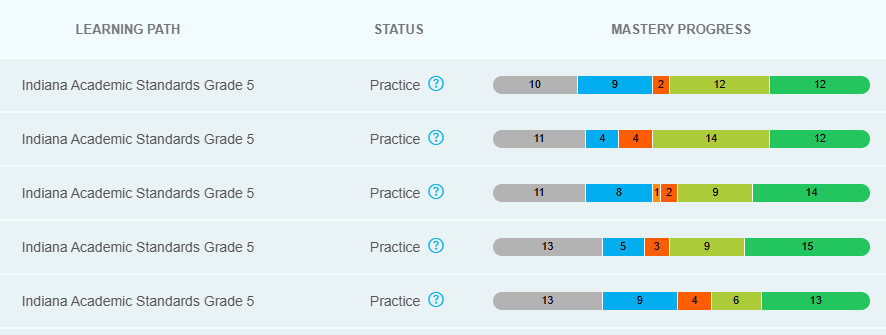
Year-Long Comprehensive Paths
Details
- Pre-built by Pathways Learning
- Aligned to a grade level and state standards
- Automatically assigned when a classroom is created
- Longer paths (~60-100 concepts)
Benefits of using Year-Long Learning Paths
- Students have the flexibility to advance through the path at their own pace, moving smoothly into the curriculum for the subsequent grade level.
- Teachers do not have to change the path periodically for each term.
- Mastery Checks are spaced out through the year due to more concepts being practiced in the path.
Term-Based Paths
Details
- Several paths designed and aligned to Scope and Sequence
- If built in advance by administrators, these can be automatically assigned upon classroom creation
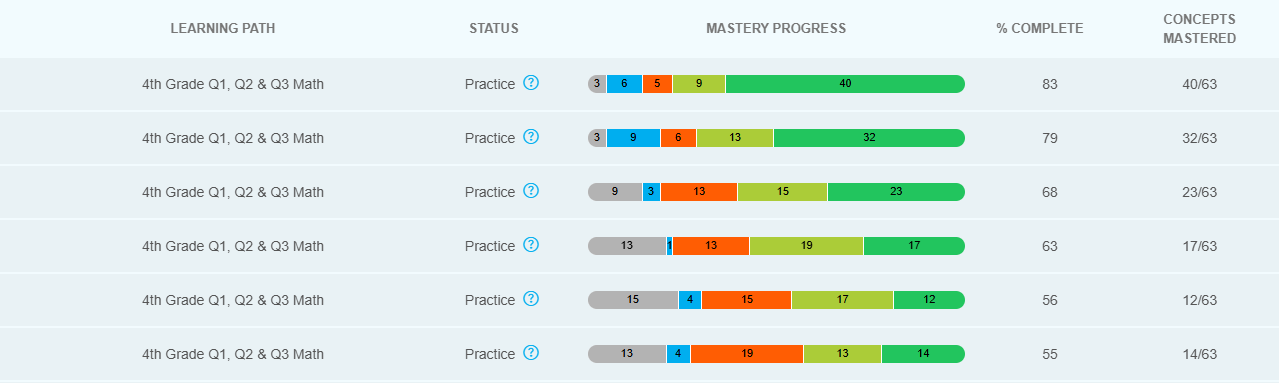
- 25-40 concepts per path
- # of paths for the year will vary based on the number of terms (i.e. quarter, trimester, marking period, set of weeks)
Benefits of using Term-Based Learning Paths
- Students have fewer concepts (red) requiring intervention, making it easier for teachers to manage assigning intervention tasks.
- Due to the strong alignment between the concepts practiced in the Learning Paths and the teacher's instruction, teachers will find they need to assign fewer supplementary assignments.

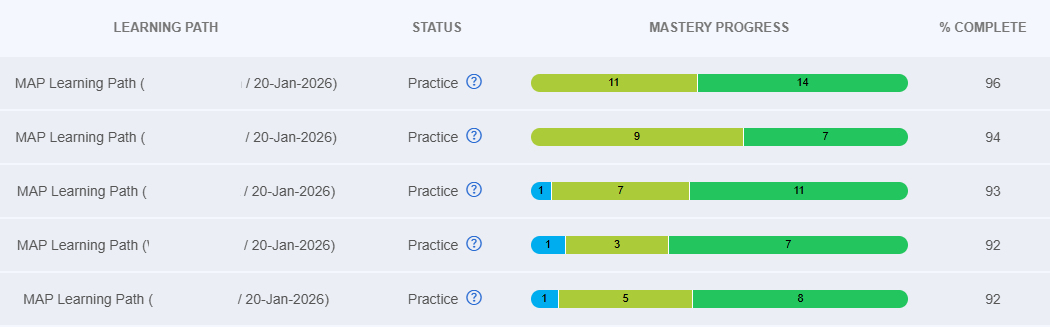
RIT Score-Aligned Paths
Details
- Learning Paths may be created 2-3 times a year
- Paths may include concepts across grade levels
- Paths are recommended to have between 24 and 40 concepts
- Assigned after classroom creation
- Important for teachers to supplement with targeted grade-level practice
Benefits of using (NWEA) RIT Score-Aligned Learning Paths
- Students receive a prescriptive path based on RIT scores.
- Teachers can track growth over time using their MAP assessments.
- Students get the benefit of receiving additional automatic scaffolding in their Learning Paths.
Topic-Based Paths
Details
- Multiple Learning Paths involved
- Tight alignment to specific topics (Fraction unit, Language practice)
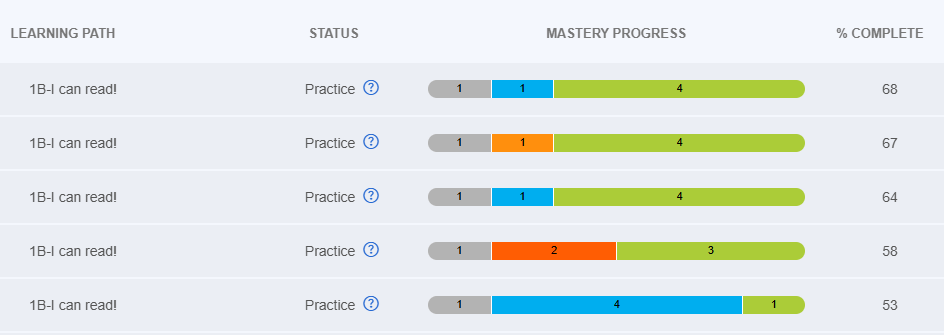
- Paths are concise (5-12 concepts)
- Temporary and intended for short-term use (1-2 weeks)
- Typically assigned after classroom creation and throughout the year
Benefits of using Topic-Based Learning Paths
- Students are able to focus on specific topics at a time.
- Streamlines the amount and the variety of intervention required for the teacher.
- Students benefit from the automatic scaffolding within the path.
Evolving Paths
Details
- One path that is continuously edited
- Path starts off short and grows to include all concepts by a certain point in time
- Can be assigned during classroom creation
- User controls the earliest date that students will access added content
Benefits of using an Evolving Learning Path
- Teachers have more control over when students start to access the new concepts.
- When a teacher modifies the Learning Path by adding new concepts, Mastery Checks for previously covered material are automatically incorporated and spread out. This design provides continuous practice for students who need it, while others focus on material they have not yet mastered.
- Students get the benefit of receiving automatic scaffolding in their Learning Paths vs. the teacher assigning the additional concepts as targeted tasks.
Tier 2 or 3 Paths
Details
- Multiple Learning Paths may be involved
- Tight alignment to specific standards based on previously identified gaps or IEPs
- Paths are concise (5-12 concepts)
- May be subject to frequent change
- Typically assigned after classroom creation and throughout the year as necessary
Benefits of using Tier 2 or 3 Learning Paths
- Prescriptive paths ensure that students can close known gaps.
- Streamlines the amount of additional intervention required for the teacher.
- Automatic scaffolding within the path provides another layer of support.
- Teachers can monitor progress periodically and show growth over time.
Related Resources
Was this article helpful?
That’s Great!
Thank you for your feedback
Sorry! We couldn't be helpful
Thank you for your feedback
Feedback sent
We appreciate your effort and will try to fix the article